I have never thought Garfield was funny. Even when I was a small child, ostensibly delighted by a mouthy orange cat obsessed with lasagna, the back of my brain said, "Why are you reading this? It's not funny. It doesn't even make sense."
Enter "Garfield minus Garfield". This blogger has removed Garfield completely from the strip. It's reminiscent of another internet phenomenon wherein folk remove Garfield's thought balloons; Jon becomes a sad, single guy who talks to his cat. "Garfield minus Garfield," however, introduces an entirely new level of misery. Jon wanders around his empty house being alternately wacky, explosively angry, or quietly despairing. It is oddly beautiful.
Friday, February 29, 2008


Monday, February 25, 2008
book thoughts
Celebration of Discipline by Richard J. Foster
A careful and heartfelt exploration of the spiritual life, it covers the disciplines of meditation, prayer, fasting, study, simplicity, solitude, submission, service, confession, worship, guidance, and celebration. We cannot expect to recognize our experiences of God, much less understand them, without effort and sacrifice on our parts. God certainly acts in our lives and we, from time to time, see it happening, but we don't know what to do with it. Foster suggests that to deepen our relationships with our brothers and sisters and with God we must be intentional in our practice, both sacred and quotidian. This is the discipline of the title.
I have said for years that I don't fast well--my body doesn't accept the lack of food and I feel ill and miserable. I thought this was a legitimate thesis. And I suppose it can be in some cases. The natural result of fasting, however, is feeling ill, hungry, and kind of empty. The whole point is the discipline of it--getting through the misery of the early stages (and sometimes the middle ones as well) can lead to significant insights into what we hunger and whose we are. Having the discipline to continue in the face of difficulty is what sets the mature apart from the immature. An acquaintance of mine simply doesn't get this in even the simplest of terms. His attitude is that if something is hard or painful, it must therefore be bad and not worth doing. So he doesn't.
Many of you may remember Dumbledore's words to Harry: "The time is coming when we will all have to choose between what is right and what is easy." The Christian life to which we are called is not easy and is not something we can take for granted. To truly change the world and to be transformed ourselves, we must take intentional action. We must discipline ourselves like soldiers or professional artists to do what needs to be done. And there is joy beyond our expectations in that discipline.
A careful and heartfelt exploration of the spiritual life, it covers the disciplines of meditation, prayer, fasting, study, simplicity, solitude, submission, service, confession, worship, guidance, and celebration. We cannot expect to recognize our experiences of God, much less understand them, without effort and sacrifice on our parts. God certainly acts in our lives and we, from time to time, see it happening, but we don't know what to do with it. Foster suggests that to deepen our relationships with our brothers and sisters and with God we must be intentional in our practice, both sacred and quotidian. This is the discipline of the title.
I have said for years that I don't fast well--my body doesn't accept the lack of food and I feel ill and miserable. I thought this was a legitimate thesis. And I suppose it can be in some cases. The natural result of fasting, however, is feeling ill, hungry, and kind of empty. The whole point is the discipline of it--getting through the misery of the early stages (and sometimes the middle ones as well) can lead to significant insights into what we hunger and whose we are. Having the discipline to continue in the face of difficulty is what sets the mature apart from the immature. An acquaintance of mine simply doesn't get this in even the simplest of terms. His attitude is that if something is hard or painful, it must therefore be bad and not worth doing. So he doesn't.
Many of you may remember Dumbledore's words to Harry: "The time is coming when we will all have to choose between what is right and what is easy." The Christian life to which we are called is not easy and is not something we can take for granted. To truly change the world and to be transformed ourselves, we must take intentional action. We must discipline ourselves like soldiers or professional artists to do what needs to be done. And there is joy beyond our expectations in that discipline.
Friday, February 15, 2008
v-day post
So, what does the deliriously happy yet appropriately cynical and modern couple do for Valentine's day? I don't know about them, but we drove to the north end of town ("God's country") to the Brazenhead for burgers and scotch, then to Target to buy a new printer, yet another set of plastic bins for comics, cheapo but cute sneakers, and fair-trade chocolate.
Flowers and romance? Pshaw. Nothing says love like a new USB cable.
Flowers and romance? Pshaw. Nothing says love like a new USB cable.
Thursday, February 14, 2008
why i love julie taymor
She thinks this is beautiful. She also thinks abandoned, broken-down docks in New York are beautiful. She thinks the mostly-blank brick wall Jude and Max can see from their apartment in Across the Universe is beautiful. She sees the elegance and the pain in everyday things and elevates them--they're not pretty in a conventional sense, but they're beautiful.
Tuesday, February 12, 2008
snow day
I don't so much get snow days. Loving Husband does as he's a school teacher. Here's a little secret: teachers are just as excited about snow days as the kids. I'm home this morning in the warmth, spending time with LH, eating a late breakfast, watching special features on Across the Universe, battling gnats--you know, the usual.
Will brave the elements (which aren't so bad as everyone says) in an hour or so. Makes me more concerned for those who have no shelter--how do they deal with the cold? with the wet?
Will brave the elements (which aren't so bad as everyone says) in an hour or so. Makes me more concerned for those who have no shelter--how do they deal with the cold? with the wet?
Saturday, February 09, 2008
book thoughts
Leaving Church by Barbara Brown Taylor
BBT is one of the most gifted preachers of the 21st century--I heard her preach in Washington, DC once and her words both convicted and raised me up. She writes about her journey as a woman and as a priest towards/with Jesus without hiding the blemishes and without glorifying her own triumphs. It's humanity longing for God at its best. Ultimately (and given the title, I don't think this is a spoiler), she leaves the church she had been pastoring, her patience with human structures fractured but her love of God undimmed. She writes, "After twenty years of serving Mother Church at the altar, I have pitched my tent in the yard, using much of what she taught me to make a way in the world" (222).
We can't give up on the things we struggle with. Sometimes we're on the margins, feeling rejected and unwanted. Sometimes we're in the center, wondering what all the fuss is about. We can never be content with where we are but listen to where God is moving. "Much that is certain at the center," says Taylor, "is up for grabs in the wilderness, while much that is real in the wilderness turns out to be far too feral for the center" (172). It's about balance, about knowing what's enough right now, about feeling the moment when change is necessary.
Taylor asks in her final chapter, "What is saving your life now?" (225) What gives you strength and hope? Who is the presence of God in your life?
BBT is one of the most gifted preachers of the 21st century--I heard her preach in Washington, DC once and her words both convicted and raised me up. She writes about her journey as a woman and as a priest towards/with Jesus without hiding the blemishes and without glorifying her own triumphs. It's humanity longing for God at its best. Ultimately (and given the title, I don't think this is a spoiler), she leaves the church she had been pastoring, her patience with human structures fractured but her love of God undimmed. She writes, "After twenty years of serving Mother Church at the altar, I have pitched my tent in the yard, using much of what she taught me to make a way in the world" (222).
We can't give up on the things we struggle with. Sometimes we're on the margins, feeling rejected and unwanted. Sometimes we're in the center, wondering what all the fuss is about. We can never be content with where we are but listen to where God is moving. "Much that is certain at the center," says Taylor, "is up for grabs in the wilderness, while much that is real in the wilderness turns out to be far too feral for the center" (172). It's about balance, about knowing what's enough right now, about feeling the moment when change is necessary.
Taylor asks in her final chapter, "What is saving your life now?" (225) What gives you strength and hope? Who is the presence of God in your life?
Friday, February 08, 2008
how life is like a hangnail
As Charlie was preaching on Ash Wednesday, I realized I was worrying a hangnail on my thumb--rubbing it back and forth, every now and again picking at it half-heartedly. It was nervous energy focused on a tiny thing that, if I could smooth it out, fix it, all would be right with the world. It was the same with the Shrove Tuesday Auction. I was very ready this year--all ducks in a regimented row--and Monday night I lay awake, my thoughts racing over miniscule details. I created short To Do lists so I wouldn't forget in the morning, going over and over them, trying to smooth out things out so all would be well.
And of course all was well--the event was wonderful. But that's the point, isn't it? Worrying something means going over and over it with your hand or in your mind, memorizing the flaws until all you can see is the flaw. How could it possibly go well with so much wrong with it--O God, how did it come to this?
The worrying of a sore doesn't help. It fills my desire to do something but that's it. More often than not my worrying a hangnail leads to blood and pain. But how to get away from the need to worry? "You cannot by worrying add to your life a single day" says Joshuah bar-Joseph. But how to stop?
In worrying a hangnail, my finger is the sole focus of my mind. I am in the midst of a crisis--there is imperfection, there is roughness, there is challenge--which must be met. The world narrows to this one thing. It's no different with a work challenge or a personal worry--the thing which gives us pain or frustration becomes the locus of everything we do. There is no distance, no space to gain perspective--the worry is all. Centuries of Christian writers have said the answer is Sabbath. We need a moment separate from our daily worry to see things as they are. Easier said than done. We are commanded several times to take a day off yet, as Richard Foster writes in Celebration of Discipline we cannot convince ourselves that it's important enough to find the time. Sabbath seems like slacking off because we don't have anything to worry, because we don't have anything to keep us busy.
The thing that worries me is not all-consuming. The thing that worries me is not all-important. The thing that worries me is not an idol. The thing that worries me will pass.
And of course all was well--the event was wonderful. But that's the point, isn't it? Worrying something means going over and over it with your hand or in your mind, memorizing the flaws until all you can see is the flaw. How could it possibly go well with so much wrong with it--O God, how did it come to this?
The worrying of a sore doesn't help. It fills my desire to do something but that's it. More often than not my worrying a hangnail leads to blood and pain. But how to get away from the need to worry? "You cannot by worrying add to your life a single day" says Joshuah bar-Joseph. But how to stop?
In worrying a hangnail, my finger is the sole focus of my mind. I am in the midst of a crisis--there is imperfection, there is roughness, there is challenge--which must be met. The world narrows to this one thing. It's no different with a work challenge or a personal worry--the thing which gives us pain or frustration becomes the locus of everything we do. There is no distance, no space to gain perspective--the worry is all. Centuries of Christian writers have said the answer is Sabbath. We need a moment separate from our daily worry to see things as they are. Easier said than done. We are commanded several times to take a day off yet, as Richard Foster writes in Celebration of Discipline we cannot convince ourselves that it's important enough to find the time. Sabbath seems like slacking off because we don't have anything to worry, because we don't have anything to keep us busy.
The thing that worries me is not all-consuming. The thing that worries me is not all-important. The thing that worries me is not an idol. The thing that worries me will pass.
Thursday, January 24, 2008
photographic brilliance
This guy is a photographer with no legs. He travels around the world taking photos of people as they stare at him and he talks about the reactions he gets. Fascinating stuff. After you read his statement, check out the gallery. I believe he's got the Holy Spirit just like my friend Jake has the Spirit when he plays drums.
Wednesday, January 23, 2008
ramblings
Cleanliness is next to Godliness, they say. It’s usually one of those “mom sayings” that you think just means to clean behind your ears and put on deodorant every now and again. Or maybe you think about all those rules in the Hebrew Scriptures called the Holiness Code about what animals are clean and how unclean we all are if we touch a woman or wear mixed fibers. The weird thing is, it’s begun to make a lot of sense to me.
When I celebrate the Eucharist, I make a point to wash my hands before the service. The most effective way to prevent spreading disease is to wash your hands; at the same time, it cleans my soul, too. I feel lighter, more focused, cleaner, like I’ve just washed my mind and body. Standing in the Sacristy, listening to the choir, running hot water and soap over my hands is so ordinary yet so sacred—it’s like a deep breath. It also feels like a gesture of respect—I’m coming to the Table clean, not covered in dirt or in all the stresses of the week. There’s a reason that our Jewish and Muslim brothers and sisters take ceremonial baths before worship.
God has high expectations of us—we’re to be loving and accepting but also not take oppression or self-righteousness lightly. We’re to be holy, clean. I don’t think God expects us to be squeaky clean—we screw up and roll about in the dirt all the time—but trying to see our uncleanness is a good first step. Maybe if you spend some time cleaning up you’ll see God in the midst of that ordinary moment.
When I celebrate the Eucharist, I make a point to wash my hands before the service. The most effective way to prevent spreading disease is to wash your hands; at the same time, it cleans my soul, too. I feel lighter, more focused, cleaner, like I’ve just washed my mind and body. Standing in the Sacristy, listening to the choir, running hot water and soap over my hands is so ordinary yet so sacred—it’s like a deep breath. It also feels like a gesture of respect—I’m coming to the Table clean, not covered in dirt or in all the stresses of the week. There’s a reason that our Jewish and Muslim brothers and sisters take ceremonial baths before worship.
God has high expectations of us—we’re to be loving and accepting but also not take oppression or self-righteousness lightly. We’re to be holy, clean. I don’t think God expects us to be squeaky clean—we screw up and roll about in the dirt all the time—but trying to see our uncleanness is a good first step. Maybe if you spend some time cleaning up you’ll see God in the midst of that ordinary moment.
Tuesday, January 22, 2008
calling to mind
In the Eucharistic prayer, there is a section called the anamnesis which means "remembering" or "calling to mind." You could take it to meant that the Meal is a memorial where we remember Jesus and what he said and did. You could also dig deeper and think of it as re-enacting his sacrifice (which would be mimesis or mimicry). Or, you could think of it as sense memory--a kind of combination of rational remembering and physical action. Anamnesis is a kind of metaphysical participation in the events of long ago in the here and now. It's not just something we do but something that forms us, makes us into new people.
I have to be constantly reminded of who I am. Not my name or my address but whose I am and what I'm called to do. It is so easy to forget, to justify my selfishness, to ignore the push at my back to live into the good news. Barbara Brown Taylor writes, "I pecked God on the cheek the same way I did Ed, drying up inside for want of making love." What we do as Christians is make love with God--interpret that any way you wish. It is not about drying up inside. It is not about simply mimicry, though that can lead you to a deeper relationship eventually. It is not about becoming Jesus either, no matter how much we want to. We are called to a dance of love in which we spin faster and faster, catching sight of the other dancers and not knowing where we end and they begin. We are called to anamnesis not just on Sunday mornings but in every moment of our lives--to remember in a visceral way, in our guts, that we are loved and that we are called to love. It will be messy and uncomfortable and it will be elegant and comforting. Embrace it, embrace God, embrace your neighbor and call to mind.
I have to be constantly reminded of who I am. Not my name or my address but whose I am and what I'm called to do. It is so easy to forget, to justify my selfishness, to ignore the push at my back to live into the good news. Barbara Brown Taylor writes, "I pecked God on the cheek the same way I did Ed, drying up inside for want of making love." What we do as Christians is make love with God--interpret that any way you wish. It is not about drying up inside. It is not about simply mimicry, though that can lead you to a deeper relationship eventually. It is not about becoming Jesus either, no matter how much we want to. We are called to a dance of love in which we spin faster and faster, catching sight of the other dancers and not knowing where we end and they begin. We are called to anamnesis not just on Sunday mornings but in every moment of our lives--to remember in a visceral way, in our guts, that we are loved and that we are called to love. It will be messy and uncomfortable and it will be elegant and comforting. Embrace it, embrace God, embrace your neighbor and call to mind.
Saturday, January 19, 2008
the saga of the sink, abbreviated for your convenience
I just spent two days putting a new sink into my bathroom. That's right, two days. It was an odyssey of self-discovery and cathartic frustration. My father and I took four trips to the hardware store, one of which was easily 45 minutes long. We struggled like Titans and swore like sailors. Yesterday afternoon, we declared it finished and turned on the water for the moment of truth. It leaked. All over the place. I called the plumber.
Then my friend Mark came over. Mark, arriving with tool box in hand and a glow about his head and shoulders nigh unto a halo. He came, he saw, we conquered. We took the whole thing apart and put it back together. And, lo, the water runneth and doth not overflow.
Then my friend Mark came over. Mark, arriving with tool box in hand and a glow about his head and shoulders nigh unto a halo. He came, he saw, we conquered. We took the whole thing apart and put it back together. And, lo, the water runneth and doth not overflow.
book thoughts
The Red Tent by Anita Diamant
I love the women in my life. I value their wisdom and their experiences, even when I disagree with them. I wish I had more close female friends. I feel the power of the feminine in my gut. I wish I had a sister. And all of this is increased exponentially while reading The Red Tent.
It's about Dinah who, the Hebrew Scriptures tell us, was so beautiful that a young man fell in love with her, raped her, then asked for her in marriage. Her 12 brothers (Joseph and that lot) were enraged and agreed to the marriage only if the man and his entire city would get circumcised. Then, on the third day and while the men were still in pain from the minor surgery, the brothers snuck in and killed them all. Dinah is property, is raped, and has nothing to say for herself. She disappears between the lines, dying the death of countless women through the ages.
Diamant brings her back to life. We hear her mothers' stories and learn about life in the red tent, the women's shelter for menstruation and childbirth. We hear about their rituals and their unflinchingly difficult lives. We hear about the power of shared female history, about the beauty of menstruation.
I don't know about you, but I feel like I've made apologies for being a woman for much of my life. Certainly things are different and better in 2007CE than 2007BCE, yet I grew up hating that time of the month, feeling embarrassed about what my body was doing, disgusted, mortified that someone would find out about it. For these women, the blood signifies not shame or the end of something but life. Beginning a new cycle of the moon means new life can come. Blood is so primal, so earthy; it connects these women to the soil they till by day and to the God who created it. They say men have feared a woman's menstruation, that she bleeds but does not die, and that is why women used to be isolated from the group. But these women voluntarily and joyfully go to the red tent to sing, to celebrate their lives, to take a couple days off. Later in her life, Dina says, "What can a woman tell a man about babies and blood?" It is so personal to us and yet so universal. Why are we ashamed?
I love the women in my life. I value their wisdom and their experiences, even when I disagree with them. I wish I had more close female friends. I feel the power of the feminine in my gut. I wish I had a sister. And all of this is increased exponentially while reading The Red Tent.
It's about Dinah who, the Hebrew Scriptures tell us, was so beautiful that a young man fell in love with her, raped her, then asked for her in marriage. Her 12 brothers (Joseph and that lot) were enraged and agreed to the marriage only if the man and his entire city would get circumcised. Then, on the third day and while the men were still in pain from the minor surgery, the brothers snuck in and killed them all. Dinah is property, is raped, and has nothing to say for herself. She disappears between the lines, dying the death of countless women through the ages.
Diamant brings her back to life. We hear her mothers' stories and learn about life in the red tent, the women's shelter for menstruation and childbirth. We hear about their rituals and their unflinchingly difficult lives. We hear about the power of shared female history, about the beauty of menstruation.
I don't know about you, but I feel like I've made apologies for being a woman for much of my life. Certainly things are different and better in 2007CE than 2007BCE, yet I grew up hating that time of the month, feeling embarrassed about what my body was doing, disgusted, mortified that someone would find out about it. For these women, the blood signifies not shame or the end of something but life. Beginning a new cycle of the moon means new life can come. Blood is so primal, so earthy; it connects these women to the soil they till by day and to the God who created it. They say men have feared a woman's menstruation, that she bleeds but does not die, and that is why women used to be isolated from the group. But these women voluntarily and joyfully go to the red tent to sing, to celebrate their lives, to take a couple days off. Later in her life, Dina says, "What can a woman tell a man about babies and blood?" It is so personal to us and yet so universal. Why are we ashamed?
Thursday, January 10, 2008
surprised by joy
I got my first cat-related puncture wound today. I know what you're thinking: "You have a cat? You hate cats!" That I do. Or rather I had convinced myself I hated cats. See, I'm very allergic to their dander--so allergic that I've been known to walk into a cat-infested home and immediately begin sneezing.
Let's be clear: it's an outside cat. Period. No matter how soft-hearted I am and no matter how cold it gets, it will not enter the allergy-free zone of our home. And by "allergy-free" I mean cat-allergy-free zone--we've got piles of dust that have formed interest groups and theological debating clubs. It sleeps on the porch in a make-shift recycling bin bed and I took it to the vet for the first time today. Her name should have been something like Mahitabell or Patricia or St. Swithen but she's ended up as Kit-Kat. I saw all the deeds that are done under the sun; and see, all is vanity and a chasing after wind. Kit-Kat experienced some trepidation when the crate came out. After a few minutes of the nice method, i.e. my putting delicious food in the crate and waiting for her to go inside so I could close the cage, I gave up and just crammed her in there, legs akimbo and protesting loudly. I got scratched on my stomach for my troubles and then later at the vet she swiped with her savage claws and I began bleeding profusely from three punctures in my fingers. All the while she was either crying piteously or making a small, domesticated cat version of a roar. Very disconcerting. But, she's home, she's had shots and topical applications and has been cleared for spaying sometime in the near future.
And before you ask, I will absolutely NOT be one of those people with "My cat is smarter than your honor student" bumper stickers or cute kitten Christmas cards or any other cat-themed merchandise. Be warned--if it is given, even in jest, it will end up in the dumpster. All that said, I love Kit-Kat. She's surprisingly affectionate. She's beautiful. And I've never had a pet all my own (read: that I have to feed and pay for all it's vet bills).
Let's be clear: it's an outside cat. Period. No matter how soft-hearted I am and no matter how cold it gets, it will not enter the allergy-free zone of our home. And by "allergy-free" I mean cat-allergy-free zone--we've got piles of dust that have formed interest groups and theological debating clubs. It sleeps on the porch in a make-shift recycling bin bed and I took it to the vet for the first time today. Her name should have been something like Mahitabell or Patricia or St. Swithen but she's ended up as Kit-Kat. I saw all the deeds that are done under the sun; and see, all is vanity and a chasing after wind. Kit-Kat experienced some trepidation when the crate came out. After a few minutes of the nice method, i.e. my putting delicious food in the crate and waiting for her to go inside so I could close the cage, I gave up and just crammed her in there, legs akimbo and protesting loudly. I got scratched on my stomach for my troubles and then later at the vet she swiped with her savage claws and I began bleeding profusely from three punctures in my fingers. All the while she was either crying piteously or making a small, domesticated cat version of a roar. Very disconcerting. But, she's home, she's had shots and topical applications and has been cleared for spaying sometime in the near future.
And before you ask, I will absolutely NOT be one of those people with "My cat is smarter than your honor student" bumper stickers or cute kitten Christmas cards or any other cat-themed merchandise. Be warned--if it is given, even in jest, it will end up in the dumpster. All that said, I love Kit-Kat. She's surprisingly affectionate. She's beautiful. And I've never had a pet all my own (read: that I have to feed and pay for all it's vet bills).
Monday, December 24, 2007
Friday, December 21, 2007
where are we going? and why are we in this handbasket?
I read author Neil Gaiman's blog pretty regularly. He posts about his life, his travels, and frequently interesting and challenging links. Today he posted a link to this festering thing.
I honestly don't know where to start. With the entire heretical and unbiblical concept that God hates Creation? With the obvious joy the singers have for the music? With the upsidedown Canadian flag they're waving? I'm so shocked, I'm not even angry.
It's just...bizarre.
I honestly don't know where to start. With the entire heretical and unbiblical concept that God hates Creation? With the obvious joy the singers have for the music? With the upsidedown Canadian flag they're waving? I'm so shocked, I'm not even angry.
It's just...bizarre.
Thursday, December 13, 2007
Golden Compass thoughts
I enjoyed it. It was good, though not great. I suspect that many who've read and loved the books will be disappointed with the movie. The Magisterium (which many believe to be a thinly-veiled and sadistic Catholic Church but which reads more like an all-powerful Presbyterian/Calvinist Church) is entirely secular--no theocracy, no commentary on Original Sin, nothing. This alone is frustrating; the movie no longer has teeth.
As I'm sure you've heard, there's been much-publicized protest over the movie and the books. Some Christians believe it's too athiest (author Pullman has said some very negative things about the Church) and some athiests believe it doesn't go far enough in its criticism. I think the teens and pre-teens at whom this movie is aimed get it. It's about doubt and struggle and the world not being as clean and hopeful as we want it to be. Teens are often in the midst of figuring out who they are, what they believe, and who this God is; a movie or book that challenges them to think through these things is a win.
I've just started reading Generous Orthodoxy by Brian McLaren. He's a big name in emergent church circles and this book is a classic of the genre. In his introduction to the book he writes,
We become better, more thoughtful people when challenged to think on our own rather than told what is truth. The Magisterium characters in the movie and the book talk quite a bit about how people can't be expected to know for themselves what's right and must be told. They say that the entire system (or Church) will fall apart if people thought for themselves and came to their own conclusions. Interestingly, this is precisely the argument put forth by people who were opposed to The Da Vinci Code and The Golden Compass.
Let's be clear--certainly there are dangerous ideas out in the world and certainly a large number of folks are willing to just accept them without thinking--we don't have to accept things at face value. Our own discomfort can tell us something about the world and our relationships. When we try to protect our brothers and sisters from challenging and upsetting fiction, we do them a disservice in not allowing them to think through the question themselves. One reviewer of the movie quoted the Catholic News Service: "rather than banning the movie or books, parents might instead take the opportunity to talk through any thorny philosophical issues with their teens." And I suggest starting with the books.
EDIT: A parishioner sent me this link to a beliefnet article on the positive aspects of The Golden Compass.
As I'm sure you've heard, there's been much-publicized protest over the movie and the books. Some Christians believe it's too athiest (author Pullman has said some very negative things about the Church) and some athiests believe it doesn't go far enough in its criticism. I think the teens and pre-teens at whom this movie is aimed get it. It's about doubt and struggle and the world not being as clean and hopeful as we want it to be. Teens are often in the midst of figuring out who they are, what they believe, and who this God is; a movie or book that challenges them to think through these things is a win.
I've just started reading Generous Orthodoxy by Brian McLaren. He's a big name in emergent church circles and this book is a classic of the genre. In his introduction to the book he writes,
A friend of mine tells me it is a mistake to challenge readers to think because most readers simply want to hear what they already know and agree with, expressed with minimum personality and maximum blandness. I would probably do this if I could because those books seem to sell best, and I have kids in colleges with high tuitions. But another friend told me that learning is not the consequence of teaching or writing, but rather of thinking. So a playful, provocative, unclear, but stimulating book could actually be more worth your money than a serious, clear book that tells you what to think but doesn't make you think. (27)
We become better, more thoughtful people when challenged to think on our own rather than told what is truth. The Magisterium characters in the movie and the book talk quite a bit about how people can't be expected to know for themselves what's right and must be told. They say that the entire system (or Church) will fall apart if people thought for themselves and came to their own conclusions. Interestingly, this is precisely the argument put forth by people who were opposed to The Da Vinci Code and The Golden Compass.
Let's be clear--certainly there are dangerous ideas out in the world and certainly a large number of folks are willing to just accept them without thinking--we don't have to accept things at face value. Our own discomfort can tell us something about the world and our relationships. When we try to protect our brothers and sisters from challenging and upsetting fiction, we do them a disservice in not allowing them to think through the question themselves. One reviewer of the movie quoted the Catholic News Service: "rather than banning the movie or books, parents might instead take the opportunity to talk through any thorny philosophical issues with their teens." And I suggest starting with the books.
EDIT: A parishioner sent me this link to a beliefnet article on the positive aspects of The Golden Compass.
Wednesday, December 12, 2007
what's style got to do with it?
I have loved menswear from an early age. In high school, most of my dressy clothes were suits, shirts, vests and sweater-vests. I bought a pair of brown wing-tips when I was in 10th grade. And it's not about looking like a boy--look at Marlene Dietrich and then tell me menswear has to look boyish. No, it's about style. There's an authority present in a suit, no matter how boxy or tailored. More to the point, there's a crisp grace in the look. If you've seen a well-made (and expensive) suit, you know what I mean. It looks right. And it looks beautiful.
If you know me at all, you know I'm all about what's beautiful. I've been quoted saying that the theological concept of the Trinity never made sense to me until a professor suggested that 3 persons was elegant. What something looks like is, for me, at least half of its meaning. Thus, though Across the Universe is not the most brilliant plot, it is beautiful and therefore I loved it. Guernica or The Sparrow are powerful and transformative precisely because of their beauty.
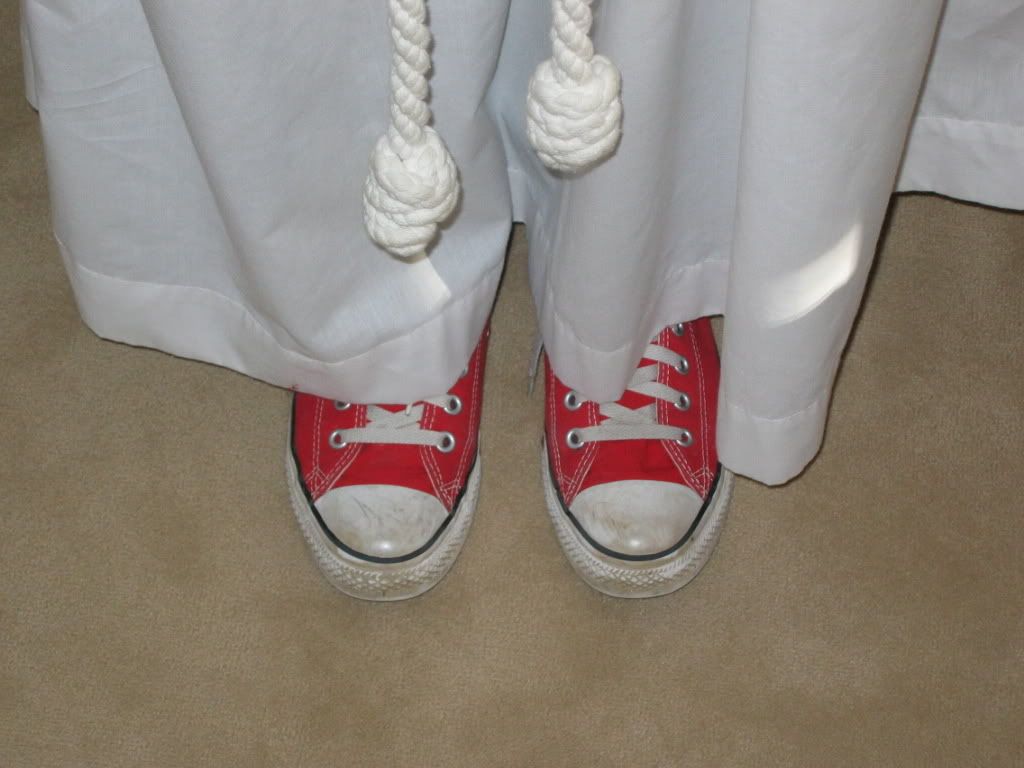
Sometime in high school, I saw Annie Lennox on MTV wearing a brown and cream pinstriped suit with burgundy velvet collar and red Chucks. I immediately went to Salvation Army and bought myself a brown and cream pinstriped suit. One of the guys I had a crush on my senior year wore orange Chucks with his tux to prom. I've noticed Ellen DeGeneres wearing sneakers with her tailored jackets and slacks. The current Doctor Who does the same and is based on Jamie Oliver's ensemble on the BBC. Knowing all this, is it any surprise that I wore red Chucks to preach in for several years?
I've been struggling with my look as a priest for some time now. I don't like neutrals, I don't like pastels, I don't even like jewel tones. I love bright colors and contrasting patterns and textures. I'm an artist and I see my daily wardrobe as a kind of canvas. As a priest, however, my look says something completely different. If I go into a meeting or hospital room in purple gingham palazzo pants, a fitted brown turtleneck, and a green bucket hat, people don't see "priest," they see "funky clothes" or similar. More to the point, the clothes become a barrier and the encounter becomes about me. There's a reason the black shirt and white collar is a classic.
I have accepted that I need to look more professional, more polished. I have pushed against this concept, called it boring. As I look back at my sartorial history, however, it seems that I've always had that crisp grace, always wanted it. I like to tweak it a bit, but the suit, the vests, the cufflinks--they're awesome.
If you know me at all, you know I'm all about what's beautiful. I've been quoted saying that the theological concept of the Trinity never made sense to me until a professor suggested that 3 persons was elegant. What something looks like is, for me, at least half of its meaning. Thus, though Across the Universe is not the most brilliant plot, it is beautiful and therefore I loved it. Guernica or The Sparrow are powerful and transformative precisely because of their beauty.
Sometime in high school, I saw Annie Lennox on MTV wearing a brown and cream pinstriped suit with burgundy velvet collar and red Chucks. I immediately went to Salvation Army and bought myself a brown and cream pinstriped suit. One of the guys I had a crush on my senior year wore orange Chucks with his tux to prom. I've noticed Ellen DeGeneres wearing sneakers with her tailored jackets and slacks. The current Doctor Who does the same and is based on Jamie Oliver's ensemble on the BBC. Knowing all this, is it any surprise that I wore red Chucks to preach in for several years?
I've been struggling with my look as a priest for some time now. I don't like neutrals, I don't like pastels, I don't even like jewel tones. I love bright colors and contrasting patterns and textures. I'm an artist and I see my daily wardrobe as a kind of canvas. As a priest, however, my look says something completely different. If I go into a meeting or hospital room in purple gingham palazzo pants, a fitted brown turtleneck, and a green bucket hat, people don't see "priest," they see "funky clothes" or similar. More to the point, the clothes become a barrier and the encounter becomes about me. There's a reason the black shirt and white collar is a classic.
I have accepted that I need to look more professional, more polished. I have pushed against this concept, called it boring. As I look back at my sartorial history, however, it seems that I've always had that crisp grace, always wanted it. I like to tweak it a bit, but the suit, the vests, the cufflinks--they're awesome.
Tuesday, December 04, 2007
ramblings
"Slow down, you move too fast.
You got to make the morning last.
Just kicking down the cobble stones.
Looking for fun and feelin’ groovy."
--Paul Simon, Art Garfunkel
We talk a lot about slowing down, seeing the signs that God and the kingdom are breaking through to this life of ours. Because I’ve constantly got songs running through my head, all I can think about is this song. You've already heard me talking ad nauseum about Sabbath and time apart, and this is kind of the theme song. This world we live in is beautiful in so many ways and yet, with the internet, telephones, cars, businesses which just don't stop, we go through it in a blur. When was the last time you or I really appreciated what we work for?
I realized this summer (as I have almost every summer) that, though I love working in my garden and it gives me a sense of peace and accomplishment, all I did was work in it. I never sat down in a chair and enjoyed what I'd done. So I began doing just that—I made myself a drink, picked up a trashy novel, and sat in the sun and was just in the garden. That was some of the most meaningful and spiritual time I've ever spent. See, it's all about the moment we're in—what do you do with it? Do you make the choice to see that God made that moment? Do you see that God gave us the ability to choose to see God?
Slow down, we move too fast—we've got to make the morning last…
You got to make the morning last.
Just kicking down the cobble stones.
Looking for fun and feelin’ groovy."
--Paul Simon, Art Garfunkel
We talk a lot about slowing down, seeing the signs that God and the kingdom are breaking through to this life of ours. Because I’ve constantly got songs running through my head, all I can think about is this song. You've already heard me talking ad nauseum about Sabbath and time apart, and this is kind of the theme song. This world we live in is beautiful in so many ways and yet, with the internet, telephones, cars, businesses which just don't stop, we go through it in a blur. When was the last time you or I really appreciated what we work for?
I realized this summer (as I have almost every summer) that, though I love working in my garden and it gives me a sense of peace and accomplishment, all I did was work in it. I never sat down in a chair and enjoyed what I'd done. So I began doing just that—I made myself a drink, picked up a trashy novel, and sat in the sun and was just in the garden. That was some of the most meaningful and spiritual time I've ever spent. See, it's all about the moment we're in—what do you do with it? Do you make the choice to see that God made that moment? Do you see that God gave us the ability to choose to see God?
Slow down, we move too fast—we've got to make the morning last…
Wednesday, November 28, 2007
ramblings
I got the coolest email today. Ok, maybe not the coolest, but in the top 25 probably.
I go to the Hunger Site every day to click on their “give free food” button. You can also click to help out with literacy, breast cancer research, and all kinds of stuff. It’s really quick and easy and awesome. So today, I got an email from Sharon, our fantastic new communications director, with a link to FreeRice. The way it works is, you get little word quizzes like “maze means: copy, argumentation, detergent, labyrinth”. You guess correctly, you give one grain of rice, then it gives you a harder word.
Now, before you give up in disgust at how nerdy your priest is, I’ll have you know I donated 240 grains of rice in about two minutes. That’s at least a couple cups (though I’ve not sat down and counted it out in my spare time). Think about how simple it is to make a difference in this world. Think about how easy it can be to begin to feed the hungry around the globe. We (and by “we” I mean everyone everywhere) have enough food to feed everyone well—it’s just not in the right places. Our grocery stores are overloaded with choices while many areas have nothing at all. Something like ¾ of the world’s population subsist on rice and beans. If that.
At FreeRice, you’re feeding other people while feeding your mind. It’s a lot like the church community at its best: we come because we are fed and because our presence feeds others. Participating in the community can be one of the most powerful relationships you’ll ever have. But only if you commit to it, only if you find creative ways to participate. We can’t sit around waiting for hunger to go away. We can’t sit around waiting for someone to invite us to participate at Redeemer, in CORe, in the faith. How are you being fed in your life? How are you feeding others?
Maybe you’re already doing this stuff. Maybe you already knew about those cool websites. Keep it up—we can’t stop until everyone is fed.
I go to the Hunger Site every day to click on their “give free food” button. You can also click to help out with literacy, breast cancer research, and all kinds of stuff. It’s really quick and easy and awesome. So today, I got an email from Sharon, our fantastic new communications director, with a link to FreeRice. The way it works is, you get little word quizzes like “maze means: copy, argumentation, detergent, labyrinth”. You guess correctly, you give one grain of rice, then it gives you a harder word.
Now, before you give up in disgust at how nerdy your priest is, I’ll have you know I donated 240 grains of rice in about two minutes. That’s at least a couple cups (though I’ve not sat down and counted it out in my spare time). Think about how simple it is to make a difference in this world. Think about how easy it can be to begin to feed the hungry around the globe. We (and by “we” I mean everyone everywhere) have enough food to feed everyone well—it’s just not in the right places. Our grocery stores are overloaded with choices while many areas have nothing at all. Something like ¾ of the world’s population subsist on rice and beans. If that.
At FreeRice, you’re feeding other people while feeding your mind. It’s a lot like the church community at its best: we come because we are fed and because our presence feeds others. Participating in the community can be one of the most powerful relationships you’ll ever have. But only if you commit to it, only if you find creative ways to participate. We can’t sit around waiting for hunger to go away. We can’t sit around waiting for someone to invite us to participate at Redeemer, in CORe, in the faith. How are you being fed in your life? How are you feeding others?
Maybe you’re already doing this stuff. Maybe you already knew about those cool websites. Keep it up—we can’t stop until everyone is fed.
apocryphal history lesson
At Bible study last night, someone asked me, "So what is the Apocrypha anyway?" Wedged into the middle of the Bible, between the Hebrew Testament and the Christian one--is a whole other book. It's got more prophets, apocalypse, history and historical fiction, wisdom, letters, and a dragon. That's right, there's a dragon in the Bible. These writings aren't canonical; that is, they're not officially part of the Bible and not authoritative the way we consider the Hebrew and Christian Testaments to be. However, they were once.
In the 3rd to 1st century BCE, a group of seventy scholars got together in Alexandria, Egypt to translate the Hebrew Testament into Greek, that text eventually called the Septuagint. The story goes that the seventy each translated the entire thing individually and every one of their translations was identical to the next. Whether or not that happened, the list of books they translated was different than the list we currently consider the Hebrew Testament. A similar thing happened when a similar (but not identical) list of books were translated into Latin to form the Vulgate in the early 400s CE. The books that didn't make it into either one were still canonical to some Christians, regardless of whether the church considered them so. Eventually they were collected into the Apocrypha and smooshed into many versions of the Christian Bible.
The word "apocryphal" means many things, from the negatively charged "of doubtful authorship or authenticity" to the more mysterious and positive "hidden things" (from the introduction of The New Oxford Annotated Bible, 2001). Scholars are still in disagreement about what it means and just why these books got the name. The key is to remember that though they are not canonical, they are still of great worth.
In the current struggles in the Episcopal Church over human sexuality and authority, it might do us good to remember that, though we disagree violently, our brothers and sisters are still of great worth.
In the 3rd to 1st century BCE, a group of seventy scholars got together in Alexandria, Egypt to translate the Hebrew Testament into Greek, that text eventually called the Septuagint. The story goes that the seventy each translated the entire thing individually and every one of their translations was identical to the next. Whether or not that happened, the list of books they translated was different than the list we currently consider the Hebrew Testament. A similar thing happened when a similar (but not identical) list of books were translated into Latin to form the Vulgate in the early 400s CE. The books that didn't make it into either one were still canonical to some Christians, regardless of whether the church considered them so. Eventually they were collected into the Apocrypha and smooshed into many versions of the Christian Bible.
The word "apocryphal" means many things, from the negatively charged "of doubtful authorship or authenticity" to the more mysterious and positive "hidden things" (from the introduction of The New Oxford Annotated Bible, 2001). Scholars are still in disagreement about what it means and just why these books got the name. The key is to remember that though they are not canonical, they are still of great worth.
In the current struggles in the Episcopal Church over human sexuality and authority, it might do us good to remember that, though we disagree violently, our brothers and sisters are still of great worth.
Subscribe to:
Posts (Atom)