The Golden Compass by Philip Pullman
One of the things I love about youth ministry is sharing books and movies. Loving Husband and I have begun loaning out graphic novels like Plain Janes, Shazam, and Scott Pilgrim. This time, Sam T, movie fanatic that he is, convinced me to watch the extended trailer for The Golden Compass. It is beautiful. So beautiful that, when I went out later that day to grab some dinner, I found myself driving to Joseph-Beth booksellers to pick up the book.
The bottom line is this: excellent book, endearing characters, complex plot and moral.
Thursday, August 30, 2007


Monday, August 27, 2007
Dreaming in Color
Politics, they say, is the art of the possible. More and more, I'm interested in the possibilities of things. Does that mean I'm a politician? Shudder to think...
A piece of fabric doesn't just sit on the shelf--it jumps up and down, waving its arms and saying "Pick me! Pick me! I've got a great idea for a project!"
A book like The Golden Compass doesn't just sit there all book-shaped and immobile--it gestures seductively saying, "You won't believe what's in here. What I can make you feel and think. Come on in."
A show like Dr. Who doesn't just entertain for a half-hour or so and is forgotten--it pokes me hard in the ribs like the little sister I never had and says, "Live your life! You're good at stuff. There's more cool things right around the corner. Keep looking!"
The current issue of the "Interchange", our diocese's newspaper, lists the Millenium Development Goals along the top banner in bright colors. The images are fun and iconic, the colors leap out at you. It all says to me, "There is possibility here. Changing the world is possible. Making a difference is not a pipe dream."
A piece of fabric doesn't just sit on the shelf--it jumps up and down, waving its arms and saying "Pick me! Pick me! I've got a great idea for a project!"
A book like The Golden Compass doesn't just sit there all book-shaped and immobile--it gestures seductively saying, "You won't believe what's in here. What I can make you feel and think. Come on in."
A show like Dr. Who doesn't just entertain for a half-hour or so and is forgotten--it pokes me hard in the ribs like the little sister I never had and says, "Live your life! You're good at stuff. There's more cool things right around the corner. Keep looking!"
The current issue of the "Interchange", our diocese's newspaper, lists the Millenium Development Goals along the top banner in bright colors. The images are fun and iconic, the colors leap out at you. It all says to me, "There is possibility here. Changing the world is possible. Making a difference is not a pipe dream."
Friday, August 24, 2007
take forgiveness any way you can get it
Forgiveness
by Terence Winch
Father Cahir kept us holy.
He smoked cigars in the confessional.
He had a distracted air about him,
as though he wasn't sure what
he was supposed to do next.
I don't remember what he taught.
History, probably. It was his
liberal attitude as a confessor
that made him a legend.
No matter what you confessed to,
he always barked out the same penance:
"Three Hail Marys and a Good Act
of Contrition. Next!" So we tested
this leniency, confessing
to rape, murder, burglary.
Cahir paid no attention.
He knew we were a bunch
of high school punks.
Puffing his cigar,
he'd issue his standard
penance and absolve all sins,
real or imagined,
with godlike aloofness,
his vast indifference to
or total acceptance of the darkness
within the human soul
exactly how I hope the deity
regards us. Take forgiveness
any way you can get it.
by Terence Winch
Father Cahir kept us holy.
He smoked cigars in the confessional.
He had a distracted air about him,
as though he wasn't sure what
he was supposed to do next.
I don't remember what he taught.
History, probably. It was his
liberal attitude as a confessor
that made him a legend.
No matter what you confessed to,
he always barked out the same penance:
"Three Hail Marys and a Good Act
of Contrition. Next!" So we tested
this leniency, confessing
to rape, murder, burglary.
Cahir paid no attention.
He knew we were a bunch
of high school punks.
Puffing his cigar,
he'd issue his standard
penance and absolve all sins,
real or imagined,
with godlike aloofness,
his vast indifference to
or total acceptance of the darkness
within the human soul
exactly how I hope the deity
regards us. Take forgiveness
any way you can get it.
Tuesday, August 21, 2007
Book Thoughts
34 On Mexican Time by Tony Cohan
Memoir of an American writer living in San Miguel de Allende, Mexico with his Japanese-American artist wife. Have read from this genre before and have read better examples (Peter Mayle comes to mind). Still, it made me want to repaint our house in garish colors and grill corn and tamales.
"Mexican time" refers to the cultural attitude of unhurriedness in Mexico. Folk say manana which means tomorrow but can mean sometime soon or eventually or whenever. Siesta is a national past time and "getting things done" requires a relaxed attitude completely foreign to our rat-race culture. It's certainly not all fun and games given the huge rates of poverty and corruption. Nobody's perfect after all. I want to remember "Mexican time" here, though. When I get overwhelmed with plans for the program year or parishioners' worries, plans, or anger, I need to remember that there is space to think and breathe and let it go.
Memoir of an American writer living in San Miguel de Allende, Mexico with his Japanese-American artist wife. Have read from this genre before and have read better examples (Peter Mayle comes to mind). Still, it made me want to repaint our house in garish colors and grill corn and tamales.
"Mexican time" refers to the cultural attitude of unhurriedness in Mexico. Folk say manana which means tomorrow but can mean sometime soon or eventually or whenever. Siesta is a national past time and "getting things done" requires a relaxed attitude completely foreign to our rat-race culture. It's certainly not all fun and games given the huge rates of poverty and corruption. Nobody's perfect after all. I want to remember "Mexican time" here, though. When I get overwhelmed with plans for the program year or parishioners' worries, plans, or anger, I need to remember that there is space to think and breathe and let it go.
Friday, August 17, 2007
Book Thoughts
Something Rotten by Jasper Fforde
Fourth in the Thursday Next series about time travel, toast, literary detectives, croquet, corrupt and fictional politicians, Neanderthals, slapstick, and social commentary. Hilarious throughout but primarily for Fforde's depiction of modern politics and media--painfully honest and ridiculously pointed. After a heated exchange on the show Evade the Question, the host clarifies the two politicians' standings from the debate:
"At the end of the first round, I will award three points to Mr. Kaine for an excellent nonspecific condemnation, plus one bonus point for blaming the previous government and another for successfully mutating the question to promote the party line. Mr. van de Poste gets a point for a firm rebuttal, but only two points for his condemnation as he tried to inject an impartial and intelligent observation." (p. 50. New York, NY: Penguin, 2004.)
The only issue I'd bring up is Fforde's tendency to give exposition several times for the same character or event. Three-quarters of the way through, I was being given information on a character I not only remembered from previous books but had been brought up to speed on at least once already. Ultimately, only mildly annoying, though.
Good stuff.
Fourth in the Thursday Next series about time travel, toast, literary detectives, croquet, corrupt and fictional politicians, Neanderthals, slapstick, and social commentary. Hilarious throughout but primarily for Fforde's depiction of modern politics and media--painfully honest and ridiculously pointed. After a heated exchange on the show Evade the Question, the host clarifies the two politicians' standings from the debate:
"At the end of the first round, I will award three points to Mr. Kaine for an excellent nonspecific condemnation, plus one bonus point for blaming the previous government and another for successfully mutating the question to promote the party line. Mr. van de Poste gets a point for a firm rebuttal, but only two points for his condemnation as he tried to inject an impartial and intelligent observation." (p. 50. New York, NY: Penguin, 2004.)
The only issue I'd bring up is Fforde's tendency to give exposition several times for the same character or event. Three-quarters of the way through, I was being given information on a character I not only remembered from previous books but had been brought up to speed on at least once already. Ultimately, only mildly annoying, though.
Good stuff.
Tuesday, August 14, 2007
Book Thoughts
The Bloody Chamber by Angela Carter
Several short stories re-telling classic fairy tales in a much more gruesome and odd manner. Actually, probably not more gruesome than the Brothers Grimm, but more modern, more weird, more feminist, more wordy. Really more wordy. Loving Husband loves Angela Carter precisely for her wordiness and word choices--she uses words you you never hear and in combinations that make your head feel thick. Honestly, I didn't like it. Reminded me of Dickens who also needed a good editor. But the stories are good and interesting and it's a quick read.
Several short stories re-telling classic fairy tales in a much more gruesome and odd manner. Actually, probably not more gruesome than the Brothers Grimm, but more modern, more weird, more feminist, more wordy. Really more wordy. Loving Husband loves Angela Carter precisely for her wordiness and word choices--she uses words you you never hear and in combinations that make your head feel thick. Honestly, I didn't like it. Reminded me of Dickens who also needed a good editor. But the stories are good and interesting and it's a quick read.
Wednesday, August 08, 2007
I'm Hungry
Bruce preached this evening on St. Dominic and, in part, on the collect of the day: "Make your church, dear Lord, in this and every age, attentive to the hungers of the world." He called the five of us present to be aware of what the people around us are hungry for, conversation, meaning, justice, food.
What am I hungry for? I mean, really hungry, not late-nite-I'm-bored-so-I'll-eat-this-junk-food. And, lest I forget dramatic tension and the struggle of faith, what hungers do I fill in this world? It's not about me, you know. Just 'cause I have my own blog doesn't mean I'm a megalomaniac. Who is hungry around me who I can satisfy? What emptiness needs to be filled?
What am I hungry for? I mean, really hungry, not late-nite-I'm-bored-so-I'll-eat-this-junk-food. And, lest I forget dramatic tension and the struggle of faith, what hungers do I fill in this world? It's not about me, you know. Just 'cause I have my own blog doesn't mean I'm a megalomaniac. Who is hungry around me who I can satisfy? What emptiness needs to be filled?
Tuesday, August 07, 2007
Book Thoughts
The Tipping Point: How Little Things Can Make a Big Difference by Malcolm Gladwell
Trends, social change, crime, marketing, suicide--they're all epidemics. They all begin with something seemingly insignificant and rise (or shrink) exponentially until they "tip." Kind of like water reaching the boiling point. The concept of a social epidemic makes a lot of sense to me. Christianity would not have caught on except for some contagious behavior by a few people. Groups form around ideas because of the contagious behavior of cool, connected people. Look at the Crocs trend if you don't believe me. A few beach bums wore them on the West Coast and now suddenly everyone and their sister has a pair.
Gladwell talks about the people who effect these changes: Mavens, Connectors, and Salesmen. He talks about Stickiness--how to get your message to stick in people's minds and behavior. He talks about Context--people do or don't do things based mostly around what their environment looks like, not rationality.
Fascinating book and well worth the read. I'm still marinating on it but here's the thing: it's true. Like Johnny Cash sings the truth. Like you feel at the end of Life is Beautiful. I completely resonate with Gladwell's points, and I can't help thinking how to leverage them into my ministry.
Trends, social change, crime, marketing, suicide--they're all epidemics. They all begin with something seemingly insignificant and rise (or shrink) exponentially until they "tip." Kind of like water reaching the boiling point. The concept of a social epidemic makes a lot of sense to me. Christianity would not have caught on except for some contagious behavior by a few people. Groups form around ideas because of the contagious behavior of cool, connected people. Look at the Crocs trend if you don't believe me. A few beach bums wore them on the West Coast and now suddenly everyone and their sister has a pair.
Gladwell talks about the people who effect these changes: Mavens, Connectors, and Salesmen. He talks about Stickiness--how to get your message to stick in people's minds and behavior. He talks about Context--people do or don't do things based mostly around what their environment looks like, not rationality.
Fascinating book and well worth the read. I'm still marinating on it but here's the thing: it's true. Like Johnny Cash sings the truth. Like you feel at the end of Life is Beautiful. I completely resonate with Gladwell's points, and I can't help thinking how to leverage them into my ministry.
Monday, August 06, 2007
True Fact
Hershey's Dark Chocolate Syrup--essentially liquid chocolate bar--is quite possibly the most awesome thing ever created.
Sunday, August 05, 2007
Another Triumphant Return
Hah! I'm back from our exotic mission trip to far off Cincinnati, Ohio. "But you live in Cincinnati" I hear you saying. That, my friends, is what made it awesome.
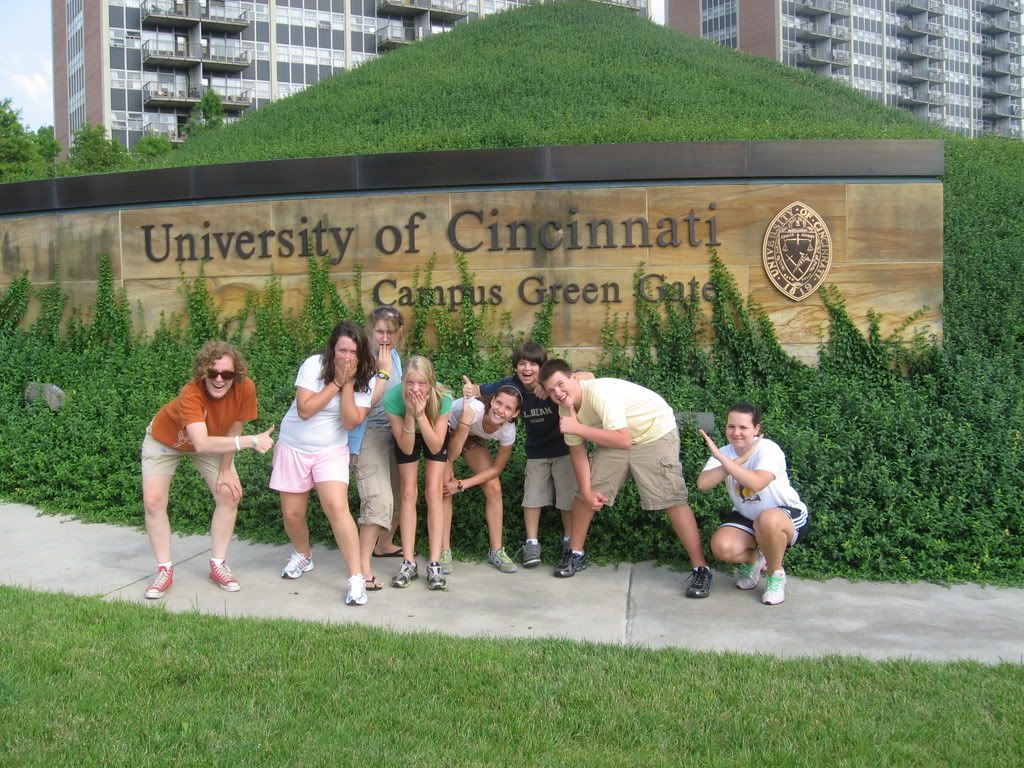
I wasn't sure if the junior high youth I had with me would think it was lame or not and I'm pleased to report they thought it was great. The church where we stayed (with 100 youth from across the country) was literally 7 minutes from Redeemer. We loaded up in the rented van, and set off on an epic journey around I275. That's right, we drove 1 1/2 hours on the interstate through three states to get 7 minutes down the road. It was fantastic. We stopped on our way into Distant Cincinnati and took a touristy photo at the University of Cincinnati. We talked about the town as though we were from elsewhere. We remarked on how the air smelled cleaner, the people seemed nicer, and the accommodations more foreign.
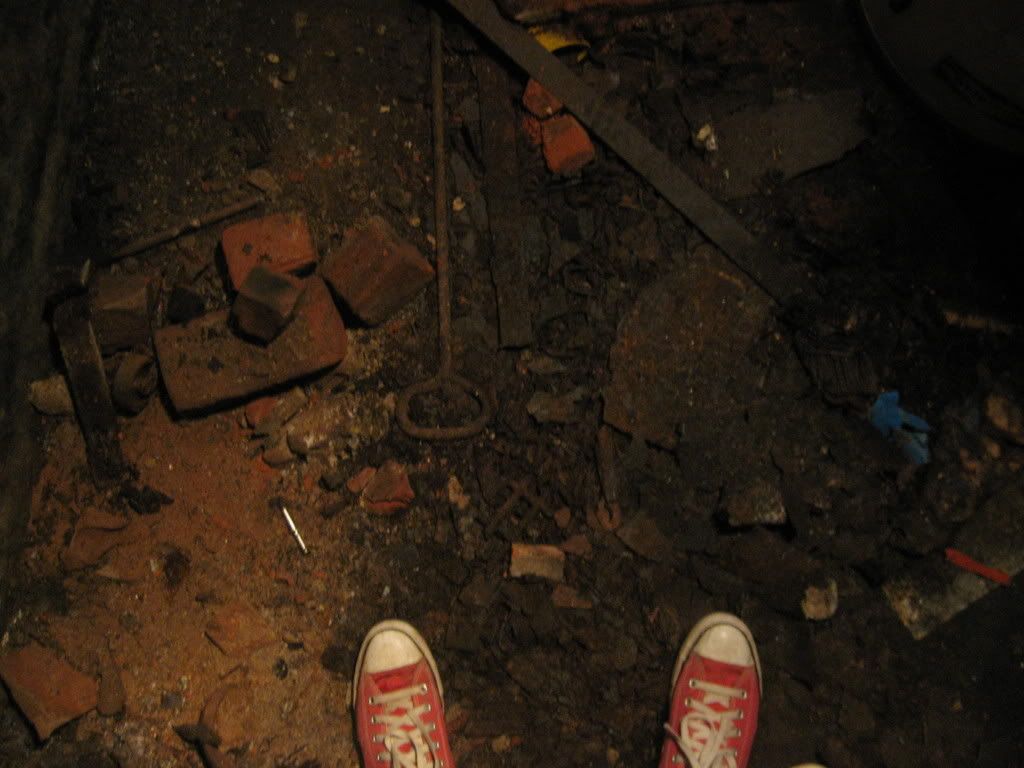
Our actual volunteering time was split between the nursing home and the Community Land Co-op. The first was lovely but the second is where the kids really shone. It was hard, dirty, disgusting labor. We went to several abandoned and condemned houses to begin cleanup so they could be rehabbed into fabulous affordable housing. The before and after photos they have at the office are just amazing--from burnt-out disaster to suburban clean. In the first house, the dank basement was lit only by a couple flashlights and an extension light where we stood calf-deep in garbage and debris. Crackheads had stolen the copper pipes a month earlier, flooding the basement. We spent a couple hours hauling out damp and degraded wood, dolls, clotheshangars, bottles, tires, window screens, and a vast amount of Undetermined Crap. It was horrible and hot and exactly what I wanted out of a mission site for these kids. The next house had both live roaches scurrying about and dead roaches crushed in the edges of the refrigerator door. The next one smelled of Something Dreadful covered up by the smell of Pine Sol.
Seriously, these teens have seen what conditions can be like in their own town. They've never even conceived of how bad things can get. And now they want to raise money and volunteers for the co-op. I'm so proud. It could not have gone better.
I wasn't sure if the junior high youth I had with me would think it was lame or not and I'm pleased to report they thought it was great. The church where we stayed (with 100 youth from across the country) was literally 7 minutes from Redeemer. We loaded up in the rented van, and set off on an epic journey around I275. That's right, we drove 1 1/2 hours on the interstate through three states to get 7 minutes down the road. It was fantastic. We stopped on our way into Distant Cincinnati and took a touristy photo at the University of Cincinnati. We talked about the town as though we were from elsewhere. We remarked on how the air smelled cleaner, the people seemed nicer, and the accommodations more foreign.
Our actual volunteering time was split between the nursing home and the Community Land Co-op. The first was lovely but the second is where the kids really shone. It was hard, dirty, disgusting labor. We went to several abandoned and condemned houses to begin cleanup so they could be rehabbed into fabulous affordable housing. The before and after photos they have at the office are just amazing--from burnt-out disaster to suburban clean. In the first house, the dank basement was lit only by a couple flashlights and an extension light where we stood calf-deep in garbage and debris. Crackheads had stolen the copper pipes a month earlier, flooding the basement. We spent a couple hours hauling out damp and degraded wood, dolls, clotheshangars, bottles, tires, window screens, and a vast amount of Undetermined Crap. It was horrible and hot and exactly what I wanted out of a mission site for these kids. The next house had both live roaches scurrying about and dead roaches crushed in the edges of the refrigerator door. The next one smelled of Something Dreadful covered up by the smell of Pine Sol.
Seriously, these teens have seen what conditions can be like in their own town. They've never even conceived of how bad things can get. And now they want to raise money and volunteers for the co-op. I'm so proud. It could not have gone better.
Sunday, July 29, 2007
The Exciting Nature of Missions
We're off! My partner-in-crime Bob M and I are loading into a HUGE white van with 7 eighth and ninth graders this afternoon. In moments, actually.
If I'm honest, I'm exhausted. I know I'm not sleeping enough and this week is not going to help that. I desperately need to work on my Sabbath-taking. On the other hand, I'm excited about spending time with these folk--they're awesome and excited about the trip, even though it's to Cincinnati, where we're from.
Exhaustion and excitement. Ambivalence and happiness. Bad and good. Isn't that always the way?
If I'm honest, I'm exhausted. I know I'm not sleeping enough and this week is not going to help that. I desperately need to work on my Sabbath-taking. On the other hand, I'm excited about spending time with these folk--they're awesome and excited about the trip, even though it's to Cincinnati, where we're from.
Exhaustion and excitement. Ambivalence and happiness. Bad and good. Isn't that always the way?
Monday, July 23, 2007
The Problematic Nature of Mission
Leaving for final youth trip of the summer on Sunday: a fabulous mission trip to...wait for it...Cincinnati! That's right, we're doing mission in our own backyard. And I say, "why not?" You don't have to go to an exotic, tourist destination to find poor, suffering people. It's even a bit selfish to spend so much money getting somewhere via plane or car, expending the fuel and time, when the world needs help where you live.
More to the point, it's not about us "working amongst" folk, condescending to offer our wisdom and cash to those less fortunate. Obviously, there are millions less fortunate than those of us in the middle class--look around you and see that we don't live in a perfect world. But that phrase, "less fortunate," is a comparative one. They are less fortunate; we are more fortunate. It almost implies that we are somehow favored or more beloved because of what we have. That we are better because we're not hungry, drug-addicted, or brown-skinned. I'm sure most folk don't mean any of that when they use the phrase, but when your intent is to go help a group of people, it is necessary to pay attention to your own motives and how they may be seen by the folk you want to help. Even if the work you're planning is desperately needed in a community, a superior attitude or an unwillingness to understand and participate in the culture will kill it dead.
So what is it about? Mission, it seems to me, is about developing relationship and opening our eyes to the world around us. We all live in a bubble of some kind or another. We can talk about "the plight of the poor" as long as we like, but won't understand it until we talk to someone who's struggling with feeding their children. We have to experience it ourselves before we'll truly get it. Jesus said to Thomas "Blessed are those who have not seen and yet come to believe". They may be blessed but few of us can believe like that. We need something to cling to, something to relate to. We need to be in relationship, knowing the other as a person, as one with thoughts and feelings and concerns and not just a statistic. We take teenagers on mission trips partly because they are a good source of labor for projects that need doing but mostly for them to discover just how big and complex this world is. They don't always see it, but when they do, you can see God on their faces as plain as day.
More to the point, it's not about us "working amongst" folk, condescending to offer our wisdom and cash to those less fortunate. Obviously, there are millions less fortunate than those of us in the middle class--look around you and see that we don't live in a perfect world. But that phrase, "less fortunate," is a comparative one. They are less fortunate; we are more fortunate. It almost implies that we are somehow favored or more beloved because of what we have. That we are better because we're not hungry, drug-addicted, or brown-skinned. I'm sure most folk don't mean any of that when they use the phrase, but when your intent is to go help a group of people, it is necessary to pay attention to your own motives and how they may be seen by the folk you want to help. Even if the work you're planning is desperately needed in a community, a superior attitude or an unwillingness to understand and participate in the culture will kill it dead.
So what is it about? Mission, it seems to me, is about developing relationship and opening our eyes to the world around us. We all live in a bubble of some kind or another. We can talk about "the plight of the poor" as long as we like, but won't understand it until we talk to someone who's struggling with feeding their children. We have to experience it ourselves before we'll truly get it. Jesus said to Thomas "Blessed are those who have not seen and yet come to believe". They may be blessed but few of us can believe like that. We need something to cling to, something to relate to. We need to be in relationship, knowing the other as a person, as one with thoughts and feelings and concerns and not just a statistic. We take teenagers on mission trips partly because they are a good source of labor for projects that need doing but mostly for them to discover just how big and complex this world is. They don't always see it, but when they do, you can see God on their faces as plain as day.
Book Thoughts--Girly Edition
DC comics has debuted a new line of comics aimed at teenaged girls that are actually good. Yeah, they're written and drawn by men, but not in the normal, creepy superhero style of exposed skin and little brains. These girls know who they are and what they want. I've read the first three and, though I am not a teenager, I am a girl and I love them.
Plain Janes by Castellucci and Rugg
Arty types all named Jane react against exclusivism and stupidity with guerilla art. Loving Husband says ending feels unfinished.
Regifters by Carey, Hempell, and Liew
Second of the Minx line and much better. Cute Korean girl faces her demons and kicks ass in martial arts. From the geinuses who brought you My Faith in Frankie.
Clubbing by Watson and Howard
The art's much prettier but the story is less satisfying than previous books. Goth chick goes to the country and solves a paranormal crime.
Plain Janes by Castellucci and Rugg
Arty types all named Jane react against exclusivism and stupidity with guerilla art. Loving Husband says ending feels unfinished.
Regifters by Carey, Hempell, and Liew
Second of the Minx line and much better. Cute Korean girl faces her demons and kicks ass in martial arts. From the geinuses who brought you My Faith in Frankie.
Clubbing by Watson and Howard
The art's much prettier but the story is less satisfying than previous books. Goth chick goes to the country and solves a paranormal crime.
Wednesday, July 04, 2007
Book Thoughts
The Bonesetter's Daughter by Amy Tan
A modern Chinese-American woman with problems of her own just doesn't understand her mother. Mom, in turn, didn't understand her own mother. From different eras, they each reveal pieces of their stories which ultimately form a connected whole. Well-written and engaging. Better than "Oprah-lit," I'd say, but only a little better.
I wonder, though, if I'm reflecting the cultural bias against women's stories. With notable exceptions, women's stories are traditionally centered around home, children, "women's work." When they're not about such things, they're more about feelings, emotional stories of coming-to-grips with something. Men's stories, to make a huge generalization, are about things happening, reasons being given, things changing. Moby-Dick, arguably the manliest book of all time, is all about reasoning out the parts of the whale and whaling. It's about hubris and close, manly relationships. It's about Whaling and Death. It's epic. Frequently women's stories are much smaller, less grand. My ambitious self wants stories about people who make it big, people who do great things, people who change minds and hearts and are vindicated. Many women's stories are about small things. Am I undervaluing Bonesetter's Daughter because it's too small and womanly?
A friend recently forwarded me an article on the same subject. The question was, if love and home are so very important to all of us, why do we undervalue stories about them regardless of who wrote them?
A modern Chinese-American woman with problems of her own just doesn't understand her mother. Mom, in turn, didn't understand her own mother. From different eras, they each reveal pieces of their stories which ultimately form a connected whole. Well-written and engaging. Better than "Oprah-lit," I'd say, but only a little better.
I wonder, though, if I'm reflecting the cultural bias against women's stories. With notable exceptions, women's stories are traditionally centered around home, children, "women's work." When they're not about such things, they're more about feelings, emotional stories of coming-to-grips with something. Men's stories, to make a huge generalization, are about things happening, reasons being given, things changing. Moby-Dick, arguably the manliest book of all time, is all about reasoning out the parts of the whale and whaling. It's about hubris and close, manly relationships. It's about Whaling and Death. It's epic. Frequently women's stories are much smaller, less grand. My ambitious self wants stories about people who make it big, people who do great things, people who change minds and hearts and are vindicated. Many women's stories are about small things. Am I undervaluing Bonesetter's Daughter because it's too small and womanly?
A friend recently forwarded me an article on the same subject. The question was, if love and home are so very important to all of us, why do we undervalue stories about them regardless of who wrote them?
Independence Day
I spent Independence Day doing what every red-blooded, patriotic American does: I worked on home improvement. We worked on fixing our deck, digging stones out of the back yard, and removing some truly monstrous roots from the garden. Seriously, one of them looks a bit like a huge horseradish or maybe a small mole.
At dinner with my parents, my mother and I were musing about Independence Day and what it means. So often you hear, "Give thanks for those who died to make this country free." I do give thanks for them, but that's not what we're celebrating. This is the day of the Declaration of Independence, the Colonies' beginning their insurrection against England. My mother put it well: "We said, 'NO.'" That really is the spirit of the holiday--we said no to tyranny and ambivalence and being subject to. And we said, "YES." We said yes to life, liberty, and happiness. We said yes to carving out our own destiny. We said yes to the possibility of failure. And we won.
I am very much an advocate for the separation of church and state. That said, there's a distinct similarity between that NO and YES and the NO and Yes we're asked for as Christians. The prophets and the mothers and fathers of the faith are remembered for standing up to tyranny, for saying "NO" to the powers that be. And they are beloved for saying "YES" to free will and compassion and love.
There is no guarantee that we'll succeed in this world. There is no surety that the garden I worked in today will be mine next year or even next week. There is no reason to believe that the Kingdom of God is ours here and now, and yet we Christians make the choice every day to stand up for what's right and to open our arms and hearts to the stranger. It is our experience of the holy in one another, in the Created world, in the structures and chaos of our lives which points to God.
It has been said that humans make their governments into idols. We see the safety and generosity and organization and we say, "Indeed, it is very good." And often that government can take the place of God. Ask yourself which you would choose: what is right in the eyes of God or what is right in the eyes of the government? This is not to suggest a rebellion here and now but to remind myself of where my priorities should be. God is the top of the hierarchy. I am in relationship with God as are billions of others--how do I then see the world? What does Creation look like through God's eyes rather than my own?
At dinner with my parents, my mother and I were musing about Independence Day and what it means. So often you hear, "Give thanks for those who died to make this country free." I do give thanks for them, but that's not what we're celebrating. This is the day of the Declaration of Independence, the Colonies' beginning their insurrection against England. My mother put it well: "We said, 'NO.'" That really is the spirit of the holiday--we said no to tyranny and ambivalence and being subject to. And we said, "YES." We said yes to life, liberty, and happiness. We said yes to carving out our own destiny. We said yes to the possibility of failure. And we won.
I am very much an advocate for the separation of church and state. That said, there's a distinct similarity between that NO and YES and the NO and Yes we're asked for as Christians. The prophets and the mothers and fathers of the faith are remembered for standing up to tyranny, for saying "NO" to the powers that be. And they are beloved for saying "YES" to free will and compassion and love.
There is no guarantee that we'll succeed in this world. There is no surety that the garden I worked in today will be mine next year or even next week. There is no reason to believe that the Kingdom of God is ours here and now, and yet we Christians make the choice every day to stand up for what's right and to open our arms and hearts to the stranger. It is our experience of the holy in one another, in the Created world, in the structures and chaos of our lives which points to God.
It has been said that humans make their governments into idols. We see the safety and generosity and organization and we say, "Indeed, it is very good." And often that government can take the place of God. Ask yourself which you would choose: what is right in the eyes of God or what is right in the eyes of the government? This is not to suggest a rebellion here and now but to remind myself of where my priorities should be. God is the top of the hierarchy. I am in relationship with God as are billions of others--how do I then see the world? What does Creation look like through God's eyes rather than my own?
Tuesday, June 26, 2007
Everything Costs
Returned from Navajoland Pilgrimage on Saturday evening. Only now feeling like a real person back home what with the jet lag and the humidity. By the by, Navajo actually means "horse thief" in Spanish and they prefer to be called Dine'.
Monument Valley is stunning. We remarked several times that you simply can't take a bad picture out there, but no photo will do the space and grandeur justice. The redness of the dirt, the blueness of the sky, the SPACE between the monuments...ok, I'll stop drooling.
Tano, our neighbor and guide on several hikes, told us that the monuments in the valley are sacred to the Dine'. This is holy ground. And it was won with a price. We've all read about the history of Native Americans since the white people came. We know about the destruction and exploitation. The Dine' have lived in this valley for a very long time--they were not part of the Trail of Tears--yet they have been taken advantage of for centuries. This beautiful land has cost them dearly.
Our trip to the reservation costs. The plane ticket alone is $500 or so. Plus food, SUV rentals, gasoline, materials for the work--it adds up to many thousands of dollars. Is the beauty and spiritual depth worth the money and damage to the environment from gasoline fumes? How much longer can we go out there?
I spent a lot of money on jewelry this year. We buy Dine' crafts to auction on Shrove Tuesday and send the profits back to the Episcopal Diocese on the reservation. This year, I may have overspent myself. Something like fifteen necklaces and bracelets and a lovely painted pot. Can you say "buyer's remorse"?
I return to a hundred emails and a messy office. I plunge right back in and have soon lost the calm I won on the reservation. Everything costs. Is it worth it?
Monument Valley is stunning. We remarked several times that you simply can't take a bad picture out there, but no photo will do the space and grandeur justice. The redness of the dirt, the blueness of the sky, the SPACE between the monuments...ok, I'll stop drooling.
Tano, our neighbor and guide on several hikes, told us that the monuments in the valley are sacred to the Dine'. This is holy ground. And it was won with a price. We've all read about the history of Native Americans since the white people came. We know about the destruction and exploitation. The Dine' have lived in this valley for a very long time--they were not part of the Trail of Tears--yet they have been taken advantage of for centuries. This beautiful land has cost them dearly.
Our trip to the reservation costs. The plane ticket alone is $500 or so. Plus food, SUV rentals, gasoline, materials for the work--it adds up to many thousands of dollars. Is the beauty and spiritual depth worth the money and damage to the environment from gasoline fumes? How much longer can we go out there?
I spent a lot of money on jewelry this year. We buy Dine' crafts to auction on Shrove Tuesday and send the profits back to the Episcopal Diocese on the reservation. This year, I may have overspent myself. Something like fifteen necklaces and bracelets and a lovely painted pot. Can you say "buyer's remorse"?
I return to a hundred emails and a messy office. I plunge right back in and have soon lost the calm I won on the reservation. Everything costs. Is it worth it?
Friday, June 15, 2007
Junior Birdman
Off we go, into the wild, blue yonder...
The annual pilgrimage to the Navajo reservation in Arizona begins tomorrow at 6am. Or, rather, 5am for those of us who'd like to shower before pilgrim-ing. Very much looking forward to orange mesas and blue, blue sky. Even looking forward to the plane flight and 6 hour drive to the rez. More on that later, perhaps.
In the meantime, please enjoy this photo.
The annual pilgrimage to the Navajo reservation in Arizona begins tomorrow at 6am. Or, rather, 5am for those of us who'd like to shower before pilgrim-ing. Very much looking forward to orange mesas and blue, blue sky. Even looking forward to the plane flight and 6 hour drive to the rez. More on that later, perhaps.
In the meantime, please enjoy this photo.
Wednesday, June 06, 2007
Sticky Decision
Converse is owned by Nike.
Nike is a Great Corporate Evil.
Converse is now made in Nike's foreign sweatshops.
Nike has made tentative steps to alleviate some of the biggest problems in manufacturing and human rights.
Converse All-Stars are objectively cool.
[See also the connection between McDonald's and Chipotle: McDonald's is terrible in both taste and record, but Chipotle makes an effort to buy non-hormone-bred meat and organic produce.]
What's a semi-hip, socially-concious girl to do? Completely boycott? Recognize good strides and encourage with my purchasing power? Will anyone in power hear either message? Besides, I really want new chucks...
Nike is a Great Corporate Evil.
Converse is now made in Nike's foreign sweatshops.
Nike has made tentative steps to alleviate some of the biggest problems in manufacturing and human rights.
Converse All-Stars are objectively cool.
[See also the connection between McDonald's and Chipotle: McDonald's is terrible in both taste and record, but Chipotle makes an effort to buy non-hormone-bred meat and organic produce.]
What's a semi-hip, socially-concious girl to do? Completely boycott? Recognize good strides and encourage with my purchasing power? Will anyone in power hear either message? Besides, I really want new chucks...
Roller Coasters and the Divine
Our Youth Council, the teenagers who lead our youth program at Redeemer, spent a day at Kings’ Island recently followed by a lovely barbecue at the home of Karen and Mike Staffiera. The day was meant as a “thank you” for all their hard work this past year and an opportunity for bonding among the group. It was fanTAstic. Our first ride was the new Firehawk and, if you like roller coasters at all, you’ve got to try it: once you’re strapped into your chair, it reclines. And I don’t just mean a little for a better television-watching-angle—I mean your feet are above your head. You ascend the first hill lying down, backwards, and head-first; it is fairly freaky. Then, just as you go over the top of the hill, the track rotates laterally so you are hanging prone, flying-Superman-style. And off you go! The Firehawk is amazingly smooth and worth the current wait.
Now, before you think this is just an advertisement for Kings’ Island, let me share something with you. I have a love/hate relationship with roller coasters. Specifically, I get motion-sick. Really motion-sick. I spent large portions of the day lying down on the grass, holding everyone’s hats and phones as they rode ride after ride. We’ve got several photos of me looking queasy. The first ride doesn’t bother me—it’s exhilarating to feel the wind in your hair, the palpable excitement in the crowd around you, the freedom of raising your arms and letting go. But several in a row and my stomach catches up with me.
It’s terrifying. To be strapped into a small, mechanical car and thrown at terrific speeds over hills and through the air is scary. And, if I’m honest, that’s a huge part of the love. As you climb that first hill, there is a feeling of abject fear: this will never work, we’re really high up, get me out of this thing, O God we’re going to die. But you can’t get out—it would be more dangerous for everyone if you tried to get out at the top of the hill rather than ride it out. And there is a moment at the crest of that hill when you see the face of God. At that split second, when the cars tip the balance and start down the hill, you let go. You let go of the fear, you let go of your expectations, you let go of your breath. You let go of everything and scream. It’s one of the purest moments of emptiness you can experience. And one of the purest moments of joy. To be in that single moment of fear and joy is to see God. Susie B and I joked about that as we were coming into the station after riding the Firehawk—we were both shaking and giddy, not sure how we felt about the ride yet, but certain that it had been a holy experience.
This is what it comes down to: fear and joy in one package. Kevin B did some thinking about that this past weekend at the Young Adult retreat that CORE sponsored at the Cathedral. The decisions we have to make in our lives, the experiences we have, the relationships we form, are all filled to the brim with fear and joy. We never know what will happen and our anxiety can sometimes overwhelm us, but most of us have had the experience of taking a risk and reaping a powerful reward. We sometimes go into a thing, confident in the joy it will bring only to be laid low. Everything is like this—choices, relationships with other people, relationship with God, Creation itself. That moment at the top of a roller coaster is our entire lives. I did get sick riding those coasters, but I also loved it. I loved spending time with some of the youth of our parish who are living a risky and fearful time in their lives. They are becoming who they will be. They don’t know yet who that is, but they are excited. There is joy in the unknown just as much as there is fear.
I have asked many of our youth this question and now I want to ask you: what would you do if you knew you had only six months to live? A year? What fear would you tackle? What joy would you not postpone? How would you serve God? What’s keeping you from it?
Now, before you think this is just an advertisement for Kings’ Island, let me share something with you. I have a love/hate relationship with roller coasters. Specifically, I get motion-sick. Really motion-sick. I spent large portions of the day lying down on the grass, holding everyone’s hats and phones as they rode ride after ride. We’ve got several photos of me looking queasy. The first ride doesn’t bother me—it’s exhilarating to feel the wind in your hair, the palpable excitement in the crowd around you, the freedom of raising your arms and letting go. But several in a row and my stomach catches up with me.
It’s terrifying. To be strapped into a small, mechanical car and thrown at terrific speeds over hills and through the air is scary. And, if I’m honest, that’s a huge part of the love. As you climb that first hill, there is a feeling of abject fear: this will never work, we’re really high up, get me out of this thing, O God we’re going to die. But you can’t get out—it would be more dangerous for everyone if you tried to get out at the top of the hill rather than ride it out. And there is a moment at the crest of that hill when you see the face of God. At that split second, when the cars tip the balance and start down the hill, you let go. You let go of the fear, you let go of your expectations, you let go of your breath. You let go of everything and scream. It’s one of the purest moments of emptiness you can experience. And one of the purest moments of joy. To be in that single moment of fear and joy is to see God. Susie B and I joked about that as we were coming into the station after riding the Firehawk—we were both shaking and giddy, not sure how we felt about the ride yet, but certain that it had been a holy experience.
This is what it comes down to: fear and joy in one package. Kevin B did some thinking about that this past weekend at the Young Adult retreat that CORE sponsored at the Cathedral. The decisions we have to make in our lives, the experiences we have, the relationships we form, are all filled to the brim with fear and joy. We never know what will happen and our anxiety can sometimes overwhelm us, but most of us have had the experience of taking a risk and reaping a powerful reward. We sometimes go into a thing, confident in the joy it will bring only to be laid low. Everything is like this—choices, relationships with other people, relationship with God, Creation itself. That moment at the top of a roller coaster is our entire lives. I did get sick riding those coasters, but I also loved it. I loved spending time with some of the youth of our parish who are living a risky and fearful time in their lives. They are becoming who they will be. They don’t know yet who that is, but they are excited. There is joy in the unknown just as much as there is fear.
I have asked many of our youth this question and now I want to ask you: what would you do if you knew you had only six months to live? A year? What fear would you tackle? What joy would you not postpone? How would you serve God? What’s keeping you from it?
Tuesday, May 29, 2007
Book Thoughts
Silver on the Tree by Susan Cooper (last in a series of 5)
Great stuff, this series.
Loving Husband tells me that JRR Tolkein, like many Englishmen, hated the French. He so disliked them that he personally resented the Norman Conquest in 1066. That's powerful. I bring this up because good ol' JRR and Susan Cooper have that much in common. There is implication in all the books of dislike of other countries--all these important, world-changing events happen in jolly old GB, for one thing--but in Silver she specifically calls out each of the successive invasions of the British Isles as waves of the Dark. Interesting, that, particularly since there's a scene early on in which some of the Stanton children stand up for a little boy from India who's being picked on. We are treated to a dialogue between the bully's dad and Mr. Stanton in which the bully's dad is clearly ignorant, mean, conservative, and wrong and Mr. Stanton is patient, kind, expansive, and liberal. Conservative, liberal, we know these words are malleable. I'm just saying the book's conflicted.
Great stuff, this series.
Loving Husband tells me that JRR Tolkein, like many Englishmen, hated the French. He so disliked them that he personally resented the Norman Conquest in 1066. That's powerful. I bring this up because good ol' JRR and Susan Cooper have that much in common. There is implication in all the books of dislike of other countries--all these important, world-changing events happen in jolly old GB, for one thing--but in Silver she specifically calls out each of the successive invasions of the British Isles as waves of the Dark. Interesting, that, particularly since there's a scene early on in which some of the Stanton children stand up for a little boy from India who's being picked on. We are treated to a dialogue between the bully's dad and Mr. Stanton in which the bully's dad is clearly ignorant, mean, conservative, and wrong and Mr. Stanton is patient, kind, expansive, and liberal. Conservative, liberal, we know these words are malleable. I'm just saying the book's conflicted.
Subscribe to:
Posts (Atom)